
Comfort
How comfortable or safe a word, sound, or speaking situation feels to the person, informed by their previous experiences.
Speech and Fluency Research Institute
SAFARI is preparing studies of the timing of stuttering events. By examining speech signals, physiological measurements, and participants’ own observations, we aim to identify patterns that deepen understanding of how stuttering unfolds.

Why SAFARI exists
SAFARI’s mission is to advance scientific understanding of stuttering.
The same word can feel easy to say one time and take considerable effort the next. We want to understand what changes between those attempts and what a recording alone might miss.
Our research starts with what people who stutter notice and experience. We study speech and the speaker’s experience together, without assuming that more fluent speech is a better outcome.
Check how consistently people and software identify the start of speech, pauses, and other events in the same recordings.
Examine the timing of movement and sound before speech begins, during moments of stuttering, and as speech continues.
Ask people what they anticipated and what effort they felt, and examine how those experiences relate to their history with a word, the speaking situation, and what we record.
Compare speaking attempts across occasions and across people to learn which patterns recur and which depend on the person or situation.
We aim to share our methods and findings so others can examine them and build on the work.
The purpose behind the research
A recording can capture a pause. It cannot, on its own, tell us whether someone was trying to speak, how much effort they experienced, or what that moment meant to them.
People bring different experiences and goals to speaking. We value their voices as they are and respect what each person chooses to share.
Research with people who stutterOur proposed contribution · CAM
CAM stands for Comfort, Activation, and Motor coordination. It is SAFARI’s proposed framework for investigating how a speaker’s relationship with a word or situation, their state in the moment, and the coordination of speech relate to timing and experience.
Our proposed contribution is to test whether considering those relationships adds useful scientific information beyond existing speech measurements. Participants’ accounts would be examined alongside recorded timing and clinical assessments.
How comfortable or safe a word, sound, or speaking situation feels to the person, informed by their previous experiences.
Momentary excitement, anticipation, and physiological activation. Activation is not necessarily anxiety or a negative experience.
How speech planning, initiation, timing, and muscle coordination unfold. The influence of established patterns is a hypothesis to investigate, not an assumed cause.
Across repeated occasions, do previous experiences, comfort and current activation help account for differences in speech timing or experienced effort? We plan to test specific relationships proposed by CAM and examine where they hold up and where they do not.
Research already examines anticipation before speech and activity preceding stuttering. SAFARI’s intended contribution is evidence from its specific CAM questions. Any additional value would need to be demonstrated through the studies.
CAM · Research presentation
Explore the updated slides at your own pace. The presentation defines Comfort, Activation, and Motor coordination and distinguishes the proposed framework from published findings.
Research on speech timing
Automatic Temporal Analysis of Speech
Measuring pauses and vocal events in recorded speech.
Algorithm & software
Vishruta
Yawatkar
Developed and refined the ATAS algorithm and software.
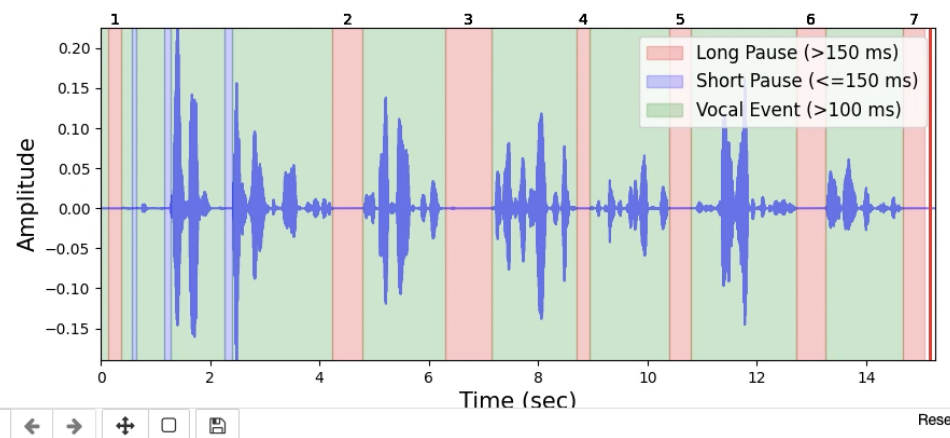
The colors distinguish timing categories in this example. A pause alone does not establish that stuttering occurred.
Peer-reviewed · 2025
Behavior Research Methods
The study examined recordings of 35 adults reading aloud. Several speech-timing measures were associated with ratings of stuttering frequency, suggesting potential for automated temporal analysis to complement existing approaches to speech assessment.
Read the studyPreprint
Not yet peer-reviewed
PsyArXiv
Extending ATAS research to children’s speech.
Read the preprintWhy support SAFARI?
Your contribution would support a focused research program: establish dependable measurements, test CAM’s proposed relationships, and report what the studies reveal. The potential value is a clearer understanding of how speaking history, personal experience, and speech timing relate—and where our explanations fall short.
fNIRS and EEG systems, muscle-activity sensors (EMG), breathing bands, and synchronized audio/video recording equipment—selected as each study requires.
Software to align speech recordings, physiological measurements, and participant observations in time, alongside speech analysis, statistics, secure data storage, and research documentation.
Time for study design, participant coordination, SLP assessments, signal analysis, statistical evaluation, interpretation, and reporting.
Suitable space for recording speech, meeting with participants, and conducting study procedures.
The first milestone your support would fund
A completed baseline study and report comparing speech measurements with independent annotations and clinical assessments. The report would document agreement, differences, repeatability, and limitations before those measurements inform further CAM studies.
The first study is in planning. Initial support would fund its preparation, recordings, assessments, and analysis. Its findings would guide the next study of CAM’s proposed relationships.
We aim to report what contributions supported, which milestones were completed, and what the evidence shows—including findings that challenge our expectations.
These are planned equipment priorities, with purchases guided by study requirements and available funding. The examples below show how established laboratories use these instruments. SAFARI would apply them to questions about timing and participant experience.
Recording and synchronization: Microphones, audio interfaces, calibrated headphones, video cameras, event-synchronization hardware, research workstations, and encrypted storage would support consistent recordings. We would check timing alignment before comparing speech, physiological measurements, and participants’ observations.
Head-mounted microphones, low-latency audio interfaces, calibrated headphones, and sound-level meters.
Research example
Boston University’s Guenther Lab uses calibrated audio setups and Audapter software to study how speakers respond to changes in the sound of their own voice. Lab methods
SAFARI’s proposed use
Create consistent recordings for speech-timing analysis and SLP comparison, then explore how speech timing and reported experience vary across speaking and listening conditions.
Multichannel electrode caps and amplifiers for recording electrical activity at the scalp.
Research example
University of Washington researchers used BioSemi ActiveTwo to examine auditory responses while adults prepared to speak or hear their recorded speech. Daliri & Max, 2015
SAFARI’s proposed use
Test whether changes before speech onset relate to speech timing and participants’ descriptions of anticipation, intention to speak, or effort.
Functional near-infrared spectroscopy (fNIRS) systems use light sources and detectors worn on the head to measure changes in blood oxygenation near the brain’s surface.
Research example
NYU and Yale researchers used Shimadzu LABNIRS to examine hemodynamic activity during a five-second period of anticipation before speaking. Jackson et al., 2022
SAFARI’s proposed use
Explore whether these slower physiological responses during speaking tasks relate to reported anticipation and effort, alongside the faster timing captured in speech recordings.
Optical motion-capture cameras and electromagnetic sensors for tracking lip, jaw, and tongue movement.
Research example
The University of Vermont’s Speech Fluency Lab lists OptiTrack and NDI Wave systems. Its research examines speech movements in relation to social stress and emotional regulation in adults who stutter. Lab research & equipment
SAFARI’s proposed use
Compare the timing of movement and sound with participants’ accounts of the interval between intending to speak and beginning to speak.
Skin-surface electrodes, multichannel amplifiers, and recording hardware for measuring electrical activity from speech-related muscles.
Research example
Boston University’s STEPP Lab combines surface EMG with acoustic and other physiological recordings to study relationships between speech signals and voice production. Lab research
SAFARI’s proposed use
Examine muscle-activity patterns around speech initiation and pauses alongside reported effort, treating the sensor measurements and personal experience as distinct information.
Chest and abdominal respiratory bands, receivers, and data-acquisition hardware for recording breathing movements alongside speech and muscle activity.
Research example
A Boston University study used Inductotrace bands and NDI Wave movement tracking to examine vocal effort in adults with typical voices. Abur et al., 2021
SAFARI’s proposed use
Investigate how breathing movements relate in time to speech initiation, pauses, and participants’ descriptions of effort during speaking tasks.
Our research approach
Our planned studies would bring together temporal speech analysis, experimental phonetics, computational approaches, and lived experience of stuttering. These perspectives would guide how measurements are defined, speaking tasks are designed, and recorded events are interpreted.
We aim to connect dependable measurements with experiments that advance understanding of how stuttering unfolds.
Planned work in temporal measurement would address event definitions, recording quality, and quantitative analysis of vocal and pause timing.
Planned work: Comparing measurements with independently reviewed recordings, evaluating measurement consistency, and identifying which measures can support further investigation.
The proposed speaking-context study would examine speech sounds, auditory feedback, and timing across linguistic contexts and individual speakers.
Planned work: Developing controlled speaking tasks, accounting for differences in sounds and syllable emphasis, and interpreting how timing responds to speaking and listening conditions.
SAFARI uses advanced AI models, including large language models, to support literature review, evidence synthesis, data compilation, exploratory analysis, and research software development. These tools help us organize evidence, connect findings across disciplines, and develop ways to examine multimodal data.
Human judgment, source verification, and reproducible methods guide how AI-assisted outputs are used.
Together with participants’ observations, these planned analyses could help identify meaningful patterns in speech timing and guide later studies of their relationship to muscle activity, breathing, and brain measurements.
Planned studies
Our first study would evaluate selected speech and pause timing measurements for the recordings and tasks we intend to study. Methods would be chosen and assessed as part of the study design.
That baseline would inform later studies of speaker experience, CAM, and speaking conditions. These studies would examine which patterns are reproducible, how they vary across people and tasks, and what they can contribute to understanding stuttering.
Establishing dependable measures of speech and pause timing.
Automatically marked boundaries could be compared with boundaries independently annotated in the same audio. Separately, speech-language pathologists would assess stuttering events.
We would examine agreement, discrepancies, and repeatability. A pause alone would not establish that stuttering occurred.
Potential outcome: Evidence identifying measurements suitable for further studies, with documented performance and limitations.
Examining the relationships between comfort, activation, motor coordination, and timing.
We would examine previous speaking experiences, current activation, anticipation and effort, and speech timing across repeated occasions within each participant.
The study would test whether CAM’s proposed relationships contribute information beyond existing measures. An observed relationship would not, on its own, establish a cause.
Potential outcome: Evidence about where recorded patterns correspond with speaker experience, where they differ, and which relationships warrant further study.
Examining how speech timing varies across speaking and listening conditions.
Controlled comparisons could examine how speech sounds, syllable emphasis, or auditory feedback relate to timing within and across speakers.
Comparable tasks and analysis would be needed to interpret individual differences across speaking and listening conditions.
Potential outcome: Evidence about timing patterns that depend on speaking conditions, helping refine explanations for later studies.
Research with people who stutter
We want participants’ perspectives to help shape the research questions and study procedures. Each person would choose what they wish to share.
Our proposed studies would bring together three sources of information.
Recordings from defined speaking tasks, with measurements of speech and pause timing.
Participants’ descriptions of what they notice and experience, including observations during tasks and reflections afterward.
SLP assessments of the same recordings, considered alongside timing measurements and participant accounts.
Studies are in planning. Participation would be voluntary, with study details and data use explained before recruitment. Participation would not require a goal of changing how someone speaks.
The institute
The Speech and Fluency Research Institute is an independent Massachusetts nonprofit dedicated to designing and conducting studies of stuttering. Our questions draw on speech science, neuroscience, psychology, and lived experience.
Our founder brings lived experience of stuttering and nearly 15 years in the highly regulated field of clinical and commercial drug manufacturing. This includes several years as a process development scientist at biotechnology companies in Cambridge, Massachusetts, developing gene-editing therapies. His work focused on methods for synthesizing—and especially purifying—synthetic DNA and RNA.
Studying molecules invisible to the naked eye required combining complementary analytical methods to distinguish meaningful signals from surrounding substances and background noise. Reliable interpretation depended on understanding the measurement conditions and carefully tailoring them to the question being investigated. That perspective shapes SAFARI’s approach to studying stuttering: bringing together speech, physiological, and self-reported data to examine patterns and relationships that any single measurement might miss.
Research on the experience of stuttering
Published study · 2022
In a laboratory speaking task, Jackson and colleagues examined a five-second anticipation period before speech. They reported associations between self-reported anticipation, brain activity, and subsequent speech behavior.
Jackson & colleagues
Neurobiology of Language
Published study · 2024
Using magnetoencephalography (MEG) in a laboratory speaking task, Orpella and colleagues reported differences in brain activity before stuttered and fluent words. They explored a possible role for inhibitory control.
Orpella & colleagues
Neurobiology of Language
Published study · July 2025
In a large genome-wide study, Polikowsky and colleagues reported 57 genomic regions associated with self-reported stuttering.
Polikowsky & colleagues
Nature Genetics
Published study · September 2025
In a study with seven adults who stutter, Lu and colleagues combined connected-speech tasks with real-time MRI to examine vocal-tract movements during moments of stuttering.
Lu, Goldstein, Byrd & Narayanan
Journal of Speech, Language, and Hearing Research
Funded project · Began August 2026
A Purdue University project aims to combine EEG, machine learning, and altered auditory feedback to investigate a system that responds to signals preceding stuttering.
Purdue University · NIH/NIDCD
R21DC024031 · Project objectives
Research links reviewed November 10, 2026.
Independent groups advancing research, education, and participation. Explore their work directly.
Computational models, behavioral experiments, and brain imaging to investigate speech production and stuttering.
Brain development, changes in childhood stuttering over time, and research on rhythm-based interventions.
Anticipation, internal experience, and brain processes preceding overt stuttering.
The experience and impact of stuttering, cognitive-affective processes, and speech neurophysiology.
Research participation opportunities and review of studies seeking to recruit through its community.
Resources for people who stutter and families, education for clinicians, and support for research.
Institute film · Synthetic narration
Our introduction to the science of speech and the questions that shape the institute.
How is a stutter created? Before a word is heard, the brain coordinates language, breath, voice, and movement.
What happens as a repetition, a prolongation, or a block emerges? How do biology and development shape the way we speak? And how do anticipation, emotion, and lived experience interact with it?
At the Speech and Fluency Research Institute, we want to investigate how these pieces connect. Our ambition: bring speech science, neuroscience, and psychology toward a unified understanding of stuttering.
When I was a kid, my hand went up whenever the teacher asked for someone to read aloud. I liked being the one who got to read the next part of the story. After I started stuttering, I’d look at a word I knew and wonder whether I could get the first sound out. For me, the fear of speaking came afterward.
Years later, I found myself raising my hand in class again. I cared about what we were learning, and I had something to say. My classmates knew I stuttered. I told them what I thought, and they listened. Little by little, I learned to give myself time to finish a thought.
I’m proud of my stutter. It’s part of why I notice when someone is still trying to say something and the conversation has already moved on. It’s also why I founded the Speech and Fluency Research Institute.
Through SAFARI, I want to design and conduct studies that advance understanding of stuttering. I want to examine what can be measured alongside what people experience, test our ideas carefully, and share what the evidence reveals.